
Bookmark these 115 vision board ideas and examples to inspire your dreams.
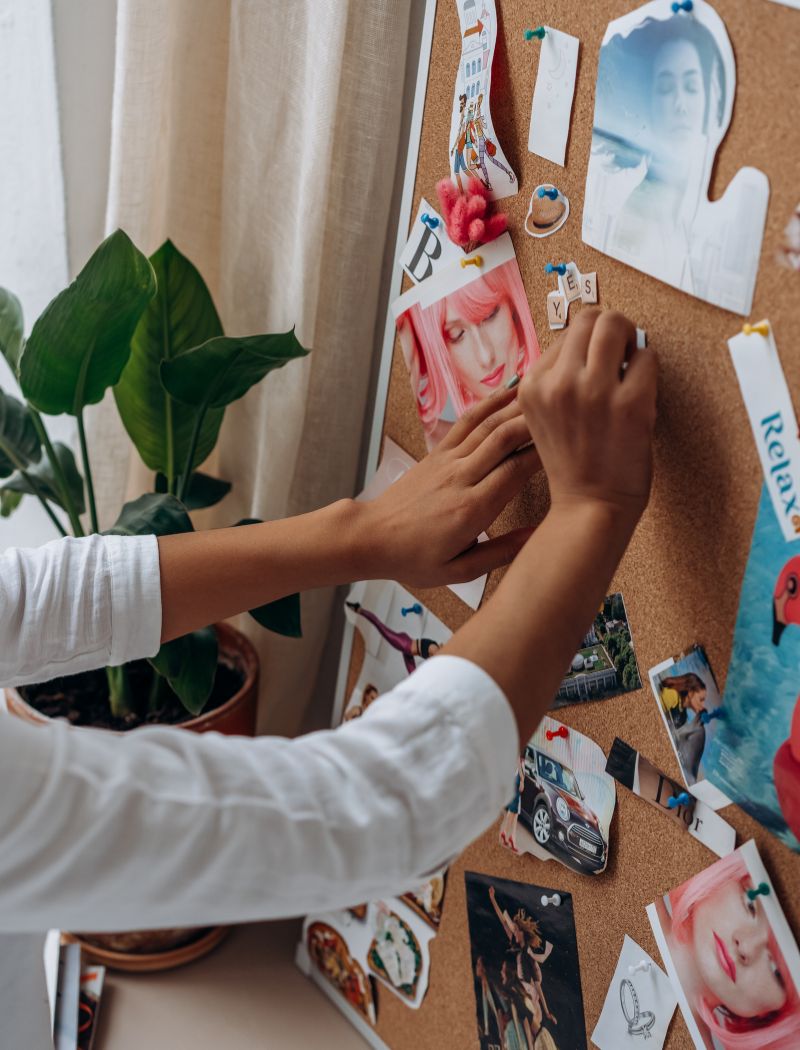
Every December, the same thing happens.
Pinterest fills up with gorgeous vision boards. Beige aesthetics. Passports. Matcha lattes. A woman in linen pants staring wistfully at the ocean.
And every December, millions of us make one, hang it up, and then completely forget it exists by February.
So let’s do it differently this year.
It’s true that as we approach the new year, there’s no better time to start visualizing the life you want than now.
It’s also quite true that a vision board is a powerful tool that helps you envision your dreams and bring them into reality IF you do it right.
In this post, you’ll get 115 vision board ideas for every area of your life, real examples to swipe, how to create yours, and — this is the good part — the psychology of making a vision board that actually works.
Let’s get into it!
What Is a Vision Board?
A vision board (also called a dream board) is a collage of images, words, and affirmations that represents your goals and the life you want to build.
Think of it as a mood board for your future: a visual summary of who you’re becoming, what you’re working toward, and how you want your life to feel.
When it’s done right, visualization isn’t wishful thinking. It’s a daily nudge that keeps your goals top of mind, so you notice opportunities, say yes to the right things, and make the aligned choice on the days you’d rather not.
Do Vision Boards Actually Work? (The Psychology)
Psychologist Gabriele Oettingen has spent years studying positive thinking, and her research suggests that people who only fantasize about the dream outcome tend to put in less effort, not more.
Your brain gets a little “I already did it” hit just from imagining the win, so the urgency to go chase it fades.
Which means a pretty board on its own can quietly work against you.
What works is pairing the vision with direction: knowing why you want something, turning it into a goal with a deadline, and building it into your actual week.
- Your vision board is the why you look at every day.
- Your goals are the what.
- Your habits are the how.
You need all three. And that’s the system we’re building below.
Types of Vision Boards
There’s no “right” format. Pick the one you’ll actually see every day.
1. Physical board: a cork board, foam board, or poster board with printed images. Classic, tactile, and perfect for a vision board party.
2. Digital board: made in Canva, Freeform, or Milanote. Easy to update, and no glue stick drama.
- Wallpaper board: a mini board set as your lock screen. You check your phone 100+ times a day, so this is the one you’ll actually see.
- Pinterest board: a secret board you add to all year. Low effort, high inspiration.
3. Journal board: a page or spread in your journal or planner. Great if you like privacy.
4. Bingo board: a 5×5 grid of goals you cross off as you hit them. This can either be a physical or digital board. It’s fun, gamified, and very ADHD-friendly.
How to Create a Vision Board for Yourself
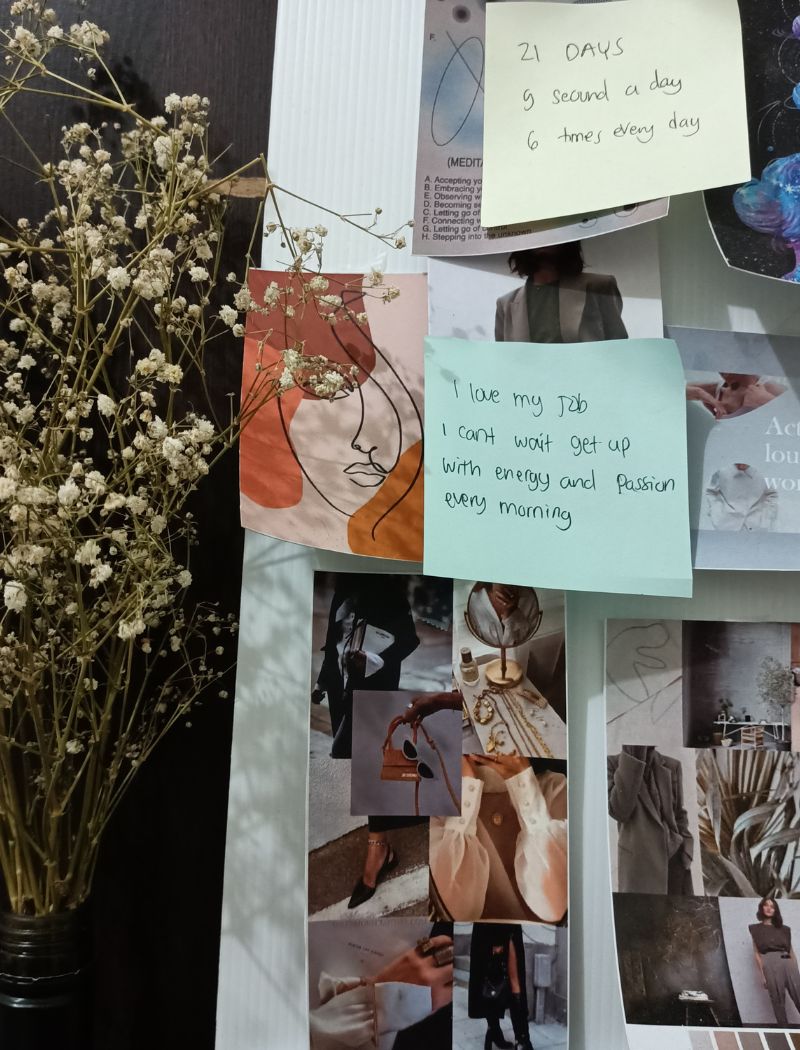
Most people start with the board. That’s backwards.
The board is the last 20% of the process, the pretty part. The first 80% is quieter: figuring out what you actually want, which parts of your life deserve your energy right now, and what each picture is supposed to turn into.
Skip that, and you end up with a very aesthetic collage of someone else’s life.
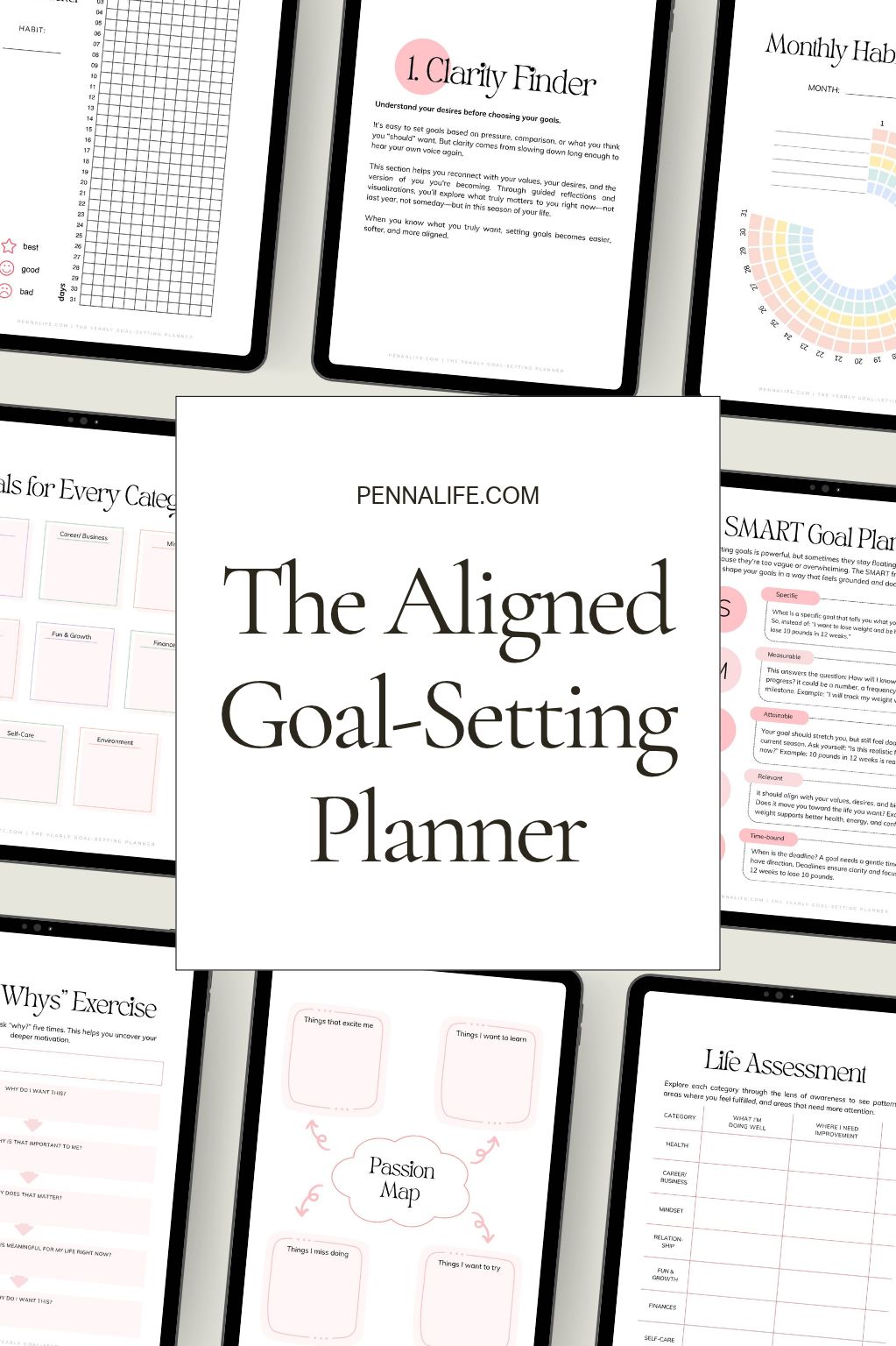
So here’s the order you should follow, and it’s the same one I built the Aligned Goal-Setting Planner around: get clear, get specific, get visible.
Step 1: Look back before you look ahead
Your board hits harder when it grows out of real experience, not just what looks good on Pinterest. So before you dream about what’s next, take an honest look at what’s behind you.
Grab a journal and answer these:
- What drained me the most?
- When did I feel most like myself?
- What did I keep saying I’d do, but never did? (No judgment. Just notice.)
- What do I want less of? What do I want more of?
You’ll spot patterns. Maybe you thrived on creative projects and wilted during back-to-back meetings. That’s data. Use it.
Want a guided version? Grab the Yearly Reset Journal. It helps you end the year with clarity and start the next one with purpose and intention, instead of dragging last year’s leftover chaos along with you.
Step 2: Get clear on what you actually want
This is the step everyone rushes, and it’s why so many vision boards feel random.
It’s easy to want things out of pressure, comparison, or because you think you “should.” But a board built on that goes hollow fast, because you can’t stay motivated by someone else’s dream.
Try this: Write about an ordinary Tuesday a year from now that you’d be genuinely happy to wake up to. Where are you? What’s on your calendar? What’s not? Don’t edit, and don’t be practical. Just collect clues.
Then notice what keeps showing up. Those repeats are your real desires, and they’re what your vision board should be built around.
This stage is called the Clarity Finder in the Goal-Setting Planner (where you discover your values, build your ideal day, and get clear on your direction) because everything gets easier once you know what you want.
Skip it, and you’ll spend January setting goals you quit by March.
Step 3: Find where the work actually is
You don’t need a goal for every area of your life.
You can “want” that, but sometimes, trying to make a big win in the major areas of your life can overwhelm you.
Zoom out and look at your life in sections: work, money, health, relationships, home, fun, growth.
Which ones are thriving? Which ones are quietly on fire? If your relationships are great and your career is a dumpster fire, it’s totally okay for your board to be 70% career. Focus where you want change.
The Goal-Setting Planner has a life assessment section to rate the categories of your life, see what you’re doing well, and what needs improvement. You can see, at a glance, where your life is lopsided.
From there, choose your top 3 to 5 goals. They become the heroes of your vision board.
Then pick one theme word for how you want to show up this season. It goes on the board in big letters.
Step 4: Give every picture a deadline
A picture of a beach is a wish. A picture of a beach with a number, a deadline, and a first step is a goal.
And that’s why setting SMART goals is a non-negotiable.
Here’s the difference:
Image: a calm Sunday and a healthy savings account
Vague goal: “Save more money.”
SMART goal: “I’ll build a $3,000 emergency fund in 12 months by moving $250 to savings on payday, and I’ll check my balance on the 1st of every month.”
The first is a vibe. The second is something you can do.
Do this for every top goal before a single image gets glued down.
The Goal-Setting Planner gives you the space to break each big goal down and make it SMART so nothing stays vague.
Step 5: Know your why (so you don’t quit in week four)
You’ll abandon the goals you don’t actually care about. It’s what it is.
So before you commit to one, ask yourself WHY you want it. Then ask why that matters. Keep going until you hit a feeling instead of a thing. This is what I call value alignment.
There’s an exercise for this in the Aligned Goal-Setting Planner, and it’s called the “5 Whys” Exercise.
For example, “make $100k” might turn out to be about freedom: deciding when to work, buying what you want, booking the trip on a whim. And that’s what belongs on your board: the trip with your mom, the Tuesday with no alarm, not just a number.
If a goal falls apart after a couple of whys because it turns out to be pressure or comparison, cut it. Better now than in week six.
Step 6: Choose a format you’ll actually see every day
A gorgeous vision board you never look at -> goals you’re never reminded of -> a version of you who does nothing about them.
So ask yourself:
- Where do I spend most of my day? At a desk: physical board or desktop wallpaper. On my phone: a digital lock screen board.
- How often will my goals change? A lot: go digital so you can edit easily.
- Do I want it private? Journal spread or a secret Pinterest board.
- Do I love hands-on projects? Physical board, 100%. Cutting and gluing is weirdly therapeutic.
You can also mix it up: a physical board in your workspace and a digital version as your phone wallpaper.
For a physical vision board, you’ll need:
- A cork board
- Magazines, printed photos, and printed Pinterest images
- Scissors
- Glue sticks, double-sided tape, or pushpins (pushpins on cork make it easy to swap things out)
- Washi tape, stickers, and markers for decoration
- Letter stickers or a label maker for words
- Optional: a frame, so it looks like art instead of a school project
🛒 Shop my vision board supply picks:
- Cork board
- Vision board magazine kit (has over 1000+ high-end images and quotes)
- Glue sticks and washi tape set
- Letter stickers
- Marker set
For a digital vision board, you’ll need:
- Canva: the easiest option for an online vision board maker. It has tons of free photos and layouts.
- Freeform (iPad and Mac): great for a free-flowing, collage-like feel.
- Pinterest: perfect if you want something you’ll keep adding to all year.
Step 7: Find images that actually mean something
This is the step that makes or breaks your board. Here’s how to choose images that pull their weight.
Be specific, not vague. “A nice house” won’t do much for you. The actual listing of a home in your dream neighborhood, with the wraparound porch you’ve always wanted, will. “Get fit” is forgettable. A photo of the exact race you’re signing up for is not.
Use the “spark test.” Look at each image for three seconds. Do you feel a little jolt of “yes, THAT”? Keep it. If you feel nothing, or worse, a twinge of guilt or pressure, toss it.
Show the feeling, not just the thing. Instead of only a photo of money, add an image of what the money gives you: a calm Sunday, a trip with your mom, a “fully booked” calendar.
Include yourself. Add a photo of you at your happiest, or a childhood photo of the little girl you’re doing this for. It makes the board feel personal, not like a stock photo collage.
Mix in words. Add your word of the year, one or two affirmations, and short phrases like “Debt free by December” or “Booked & blessed.” Browse this collections of inspiring quotes, reflective prompts, and powerful affirmations for words to add to your vision board.
Where to find images:
- Pinterest: search your goal plus “aesthetic” (e.g. “home office aesthetic”).
- Unsplash and Pexels: free, high-quality photos.
- Canva: thousands of free images built right in.
- Magazines: great for physical boards, and flipping through them often sparks ideas you didn’t know you had.
- Your camera roll: places you’ve been, people you love, moments you want more of.
Step 8: Arrange your board with intention
Don’t just glue things down at random. A little structure makes your board easier to read at a glance, and more powerful.
Try one of these layouts:
A few more arranging tips for your vision board:
1. Lay everything out before you glue anything. Take a photo of your layout so you can recreate it.
2. Make your top 3–5 goals the biggest images. Everything else is supporting cast.
3. Leave some white space. A cluttered board feels overwhelming, and a little breathing room keeps it calm.
4. Leave room to add things. Some of the best additions show up mid-year.
5. Add your SMART goals. Write the deadline in small text under each hero image, or tuck an index card in a corner. This is the secret sauce that turns your board from a wish list into a game plan.
Step 9: Put it where you’ll see it, and make it a ritual
This is the step that separates vision boards that work from the ones collecting dust by February.
First, placement. A physical board belongs in your workspace, where it can fuel your daily productivity. A digital board should be your phone or computer wallpaper. If you keep it private in a journal, set a reminder to open it every Sunday as part of your routine checklist. Private can’t turn into forgotten.
Then, the ritual:
Daily (1 minute): Look at your board, pick one image, and ask: “What’s one small thing I can do today to move toward this?” Track those small things with my free 90-day habit tracker.
Weekly (5 minutes): Every Sunday, glance at your board while you plan your week. Does your calendar actually reflect what’s on it? If not, adjust. If you want your goals, weekly plan, and routines in one place, my All-in-One Life Planner is a Google Sheets template with a goal planner tab (yearly and quarterly objectives with progress bars), a daily/weekly/monthly planner, and a routine checklist, all linked from one hub.
Monthly (20 minutes): Check in on each goal. What’s working? Where did you get stuck, and what’s one adjustment? Turn your big goals into monthly goals.
Quarterly (30 minutes): Zoom out. What are the top three things that deserve your energy for the next 90 days? (This is the part that keeps a year from blurring together, and it’s built into the Goal-Setting Planner.)
Whenever you hit a goal: Celebrate! Mark it with a gold star or a little “✓ DONE” sticker. Watching your board fill up with wins is ridiculously motivating.
Whenever a goal stops feeling right: Take it down. You’re allowed to change your mind. Your board should evolve as you do.
Whenever you hit a goal: Celebrate it! Mark it with a gold star, a check mark, or a little “✓ DONE” sticker. Watching your board fill up with wins is ridiculously motivating.
Whenever a goal stops feeling right: Take it down. You’re allowed to change your mind. Your board should evolve as you do.
Want help with the clarity-and-goals part?
That’s the part I built the Aligned Goal-Setting Planner for. It helps you:
- Figure out what you actually want before you pick a single image
- See where your life needs attention right now (and where it doesn’t)
- Turn each big goal into a plan with a deadline and a real reason behind it
- Break the whole year into quarters and months and even days, so your vision doesn’t live in a drawer
Make It a Party!
Vision boards are way more fun with friends. Host a vision board party: everyone brings magazines and snacks, you put on a playlist, and you share your boards at the end. Bonus: you’ll have built-in accountability buddies for the whole year. Click here to plan yours.
115 Vision Board Ideas Examples for You

Here are some vision board ideas for your personal and professional life.
Steal these, remix them, make them yours. Most of them line up with the main areas of your life, plus a few extras like travel and faith. Under each category, you’ll find a quick “turn it into a goal” example, so your pictures don’t stay pictures.
Career & Business Vision Board Ideas
- A business card with your dream job title
- Your ideal workspace: a sunny home office, a studio, or a corner office
- A logo of a company you want to work with or for
- A screenshot of your dream client saying “yes”
- Your name on a book cover
- A packed conference room or stage where you’re the speaker
- A podcast or magazine feature with you as the guest
- Your launch hitting its sales goal
- A 4-day workweek calendar
- A laptop on a beach (remote work, wherever you want)
- A certification or degree you’re going for
- A “You’re hired!” or “Promotion” email
- Your business’s dream brand mood board
- A team you’ve built, smiling in a meeting
- A “Fully booked” sign on your calendar
Turn it into a goal: “Fully booked” becomes “I’ll book 5 paying clients by March 31 by sending 10 pitches every week.”
Money & Financial Vision Board Ideas
- Your target savings balance written as a bank screenshot
- “Debt Free: December 2027” in big bold letters
- A paid-off credit card, cut in half
- A check written to yourself for your income goal
- Your multiple income streams sketched as a pie chart
- A fully funded emergency fund (“6 months: done ✓”)
- A first home or investment property listing
- Your first $10K month (or $100K year)
- A donation to a cause you love
- A green, happy budget app
- A credit score you’re aiming for
- A “treat yourself” item you’ll buy with cash, guilt-free
- Your retirement or investment account goal
- A “money mindset” phrase like “Money flows to me easily”
- A first-class seat you paid for with your own money
Turn it into a goal: “Debt free” becomes “I’ll pay off my $4,000 credit card in 8 months by paying $500 every month and checking my balance on the 1st.”
Track it: The finance tracker tab in my All-in-One Life Planner auto-calculates your monthly income, expenses, and savings. And if you prefer a printable tracker, get my Ultimate Finance Tracker.
Health & Fitness Vision Board Ideas
- A colorful plate of food that makes you feel good
- A finish line from a 5K, 10K, or marathon
- A yoga pose you’re working toward
- Your ideal morning workout spot
- A big water bottle (hydration queen era)
- An 8-hour sleep score
- Someone hiking up a mountain
- A pilates or dance class you want to join
- A strong, healthy body doing something fun (not a “goal body”)
- A grocery haul full of fresh produce
- A fitness streak in your favorite app
- A cozy healthy meal-prep Sunday
Turn it into a goal: The finish line becomes “I’ll run a 5K in 12 weeks by training 3 days a week and logging every run.”
Track it: The health & fitness tracker tab in the All-in-One Life Planner has a monthly progress bar so you can see how you’re doing.
Self-Care & Mental Health Vision Board Ideas
- A bubble bath with a book and candles
- A phone on “Do Not Disturb”
- A journal and a cup of tea by a window
- A therapy or coaching session on your calendar
- A spa day
- A slow Sunday with no plans
- The word “No” (boundaries are self-care)
- A meditation streak
- A digital detox weekend
- Fresh flowers you bought for yourself
- A calm, clutter-free bedroom
- A phrase like “I don’t have to earn rest”
Turn it into a goal: The slow Sunday becomes “I’ll protect one phone-free Sunday afternoon every week for the next 3 months and check it off on my habit tracker.”
Track it: The All-in-One Life Planner has self-care and routine tabs to stay on top of your habits and me-time.
Love & Relationships Vision Board Ideas
- A couple laughing together over dinner
- A weekly date night ritual
- A dream wedding or vow renewal photo
- A cozy movie night for two
- A couple traveling together
- Love letters or handwritten notes
- Words describing the relationship you want: “safe,” “playful,” “chosen”
- A couple cooking together
- A healthy-communication phrase like “We talk it out”
- A picnic date
- A home you’re building together
- A “self-love first” image, because the most important relationship is with you
Turn it into a goal: The weekly date night becomes “We’ll have one planned date night every week for 90 days, taking turns planning it.” Here are some at-home date ideas to inspire you.
Family & Friendship Vision Board Ideas
- A big, loud family dinner
- A girls’ trip with your besties
- A monthly friend date
- A Sunday call with your parents or grandparents
- A family vacation photo
- A game night
- A baby, pet, or family addition you’re hoping for
- A friendship bracelet or matching tattoo
- A holiday hosting moment
- A “new friends” image, if building community is a goal
Turn it into a goal: The monthly friend date becomes “I’ll schedule one catch-up with a friend on the first Monday of every month for the next 6 months.”
Home & Lifestyle Vision Board Ideas
- Your dream home’s exterior
- A cozy reading nook
- A kitchen you love cooking in
- A plant-filled living room
- A walk-in closet (a girl can dream)
- A garden or balcony with fairy lights
- A Pinterest-worthy home office
- A “just moved in” photo of keys
- A home library wall
- A decluttered, calm space
Turn it into a goal: The reading nook becomes “I’ll set up a reading nook by the end of next month with a $150 budget.”
Personal Growth Vision Board Ideas
- A stack of books you want to read this year
- A language you’re learning (“Fluent in Spanish”)
- A course certificate
- A morning routine checklist
- A journal labeled “365 days of writing”
- A new hobby in action: painting, pottery, guitar
- A public speaking moment
- Your word of the year
- A “comfort zone vs. where the magic happens” image
- A personal style mood board
- Someone confidently speaking up in a meeting
- A quote that sums up who you’re becoming
Turn it into a goal: “Fluent in Spanish” becomes “I’ll hold a 10-minute conversation in Spanish in 9 months by practicing 15 minutes a day and booking one tutor session a week.”
Track it: For that stack of books, the reading tracker tab in the All-in-One Life Planner lets you set a reading goal and watch your progress chart.
Travel & Adventure Vision Board Ideas
- A world map with your 2027 destinations marked
- A passport with fresh stamps
- A sunrise hot air balloon ride
- A solo trip
- A road trip with the windows down
- A beach you’ve always wanted to visit
- A cabin in the snow
- A food tour in a city you love
- A bucket-list adventure: skydiving, scuba, safari
- A “30 countries by 30” (or 40, or 50) tracker
Turn it into a goal: The solo trip becomes “I’ll take a 5-day solo trip by September by saving $200 a month and booking flights by May 1.”
Plan it: The travel planner tab in the All-in-One Life Planner covers your budget, itinerary, accommodation, and activities.
Faith & Spiritual Vision Board Ideas
- A favorite scripture or spiritual quote
- A prayer or meditation corner
- A church, retreat, or community you want to join
- A gratitude journal
- Serving or volunteering in your community
- A sunrise representing new beginnings
- A word like “trust,” “surrender,” or “peace”
Turn it into a goal: The gratitude journal becomes “I’ll write down 3 things I’m grateful for every night for 30 days.”
Bonus Vision Board Ideas for Students & Couples
For students:
- An acceptance letter from your dream school
- A GPA or grade you’re working toward
- A graduation cap
- An internship offer
- A study spot that makes you want to study
- A clubs-and-friends image for your social life
For couples:
- Your dream wedding, house, or trip together
- A savings goal you’re tackling as a team
- Your “relationship values” in words
- A weekly ritual you want to start
- Make something together on a date night
Words & Affirmations for Your Vision Board
Images are great, but words make your board say something.
Single words: abundance, freedom, peace, bold, joy, discipline, healing, expansion, home, becoming
Affirmations:
- I am becoming the woman I imagined.
- Good things are always finding their way to me.
- I do hard things.
- My work is valuable and well paid.
- I am allowed to want more.
- I trust my timing.
Want more? Grab some from my daily affirmations for women, these money manifestation affirmations and these I am affirmations.
Vision Board Examples
Here are some vision board examples to show you how it all comes together.
- Digital vision board: clean, minimal, and easy to update all year.
- Phone wallpaper vision board: three to five images and one word. Simple and powerful.
- Vision board bingo: 25 goals, one grid, and a very satisfying highlighter.
- Journal vision board: private, personal, and perfect for writers.
Vision Board FAQs
What should I put on a vision board?
Images, words, and affirmations that represent your goals in each area of life: career, money, health, relationships, home, growth, travel, and faith. Focus on what genuinely excites you, not what you think you should want, and make your top 3 to 5 goals the biggest images.
Do vision boards really work?
They work best when they’re tied to clear goals and a plan. Research by psychologist Gabriele Oettingen suggests that visualizing the dream alone can reduce effort, so pair your board with SMART goals, a deeper “why,” and a regular review ritual.
How do I turn my vision board into goals?
Give each top image a number, a deadline, and a first step, then keep asking yourself why it matters until you hit a real feeling. This Goal-Setting Planner walks you through this for every goal on your board.
When is the best time to make a vision board?
Most people make one in late December or early January. But you can make one anytime you’re starting a new chapter: a birthday, a new job, a move, or a fresh season. If you’re making yours at the end of the year, the Yearly Reset Journal is a great first step.
Should I make a physical or digital vision board?
Choose the one you’ll see the most. Physical boards are great for your workspace. Digital boards are easier to update and work perfectly as phone wallpapers.
How many pictures should a vision board have?
There’s no rule. Most boards have 10 to 30 images. A mini phone-wallpaper board can work with just three to five.
How often should I update my vision board?
Look at it daily, review your goals monthly, and refresh the whole board quarterly or whenever a goal is achieved or no longer feels true.
Creating Your Vision Board
A vision board won’t change your life by hanging on a wall.
You will. The board just reminds you who you’re doing it for.
So get clear on what you want, turn your pictures into real goals, and build them into your week. If you want help mapping all of it, grab the Aligned Goal-Setting Planner.
And if you want an aesthetic, authomated, and simple Google Sheets home base to run your days around those goals (goals, finances, routines, travel, and more), you need the All-in-One Life Planner.
Grab my 90-day habit tracker to stay consistent with these routines so you can achieve your vision board goals.